


Foundations of a Family Legacy
In 1906, brothers Oscar and Nathan Heyman arrived in New York City from Latvia, bringing with them skills forged abroad. As teenagers—just thirteen and sixteen—they had been sent to apprentice at a Fabergé workshop, where they developed the discipline, precision, and mastery that would define their work.
Oscar Heyman was hired by Pierre Cartier as the first non-French jeweler employed at the House, helping to establish Cartier’s New York workshop and earning early recognition for his expertise. Nathan excelled working in a tool-and-die shop in Long Island City, experience which would serve his future company tremendously.
In 1912, Oscar, Nathan, and their younger brother Harry founded Oscar Heyman & Brothers. In the years that followed, six more siblings joined them in New York; ultimately, eight of the nine Heyman brothers and sisters would contribute their talents to the House.
More than a century later, Oscar Heyman remains independent and family-run, stewarded by the second and third generations and recognized worldwide for exceptional jewelry.

1912
Oscar Heyman & Brothers is established by Oscar, Nathan, and Harry Heyman at 47 Maiden Lane, the heart of the New York jewelry district at the time.

1917
The first American Flag brooch is crafted for retailer Black, Starr & Frost to auction in support of the war effort. This brooch is part of the permanent collection at the Museum of Fine Arts, Boston.

1929
A patent is awarded for a pioneering platinum bracelet link and its proprietary method of construction.

1939
Becoming obvious at the opening of the New York World’s Fair, Oscar Heyman & Brothers manufactures for all five retailers in the House of Jewels, thus earning the appellation “The Jewelers’ Jeweler®.”

1950
George Heyman creates the iconic ballerina ring, transforming a parcel of tapered baguette diamonds into a composition reminiscent of a dancer’s flowing tutu.

1969
Oscar Heyman & Brothers is commissioned to design and manufacture a necklace for Cartier, transforming a 69-carat diamond into the legendary jewel created for Elizabeth Taylor and gifted by Richard Burton.

1972
Oscar Heyman creations travel to the moon aboard Apollo 16, carried by astronauts who were gifted gemstone-encrusted medallions.

2003
In partnership with Stuart Weitzman, Wizard of Oz–inspired stiletto featuring 642 Burmese rubies totaling over 120 carats, were crafted by Oscar Heyman. At the time, they were valued over one million dollars.

2012
Oscar Heyman celebrates it's 100th anniversary. A 6.54-carat Internally Flawless Fancy Intense Pink Diamond ring owned by Evelyn Lauder auctions for $8.5 million dollars.

2017
Museum of Fine Arts, Boston publishes a book celebrating and honoring Oscar Heyman’s decades of contributions to American jewelry manufacturing and design.

2025
Second generation owner Adam Heyman celebrates 60 years at the company. He is pictured here with his father, George, the youngest of the founding generation, on a stone buying trip in India, ca. 1970.

The Makers Behind the Masterpieces
From the beginning, the House was defined by a profound devotion to craft, achieving standards few workshops could equal. Oscar and Harry were talented jewelers, while Nathan brought the skills of a trained tool-and-die maker. Together, their combined knowledge bridged artistry and engineering, leading to seven patents for jewelry design and construction filed between 1916 and 1942.
That commitment to technical excellence endures. Highly complex designs are embraced and celebrated. The House maintains its own tool-and-die shop—now a rarity in an industry increasingly reliant on casting and CAD. There, each setting and component is formed from solid plates of precious metal, producing pieces of remarkable durability and refinement.

A Tradition of Rare and Remarkable Gems
The pursuit of superlative stones has always been fundamental to Oscar Heyman. From the earliest days of the House, its buyers traveled the world, cultivating enduring relationships with master gem cutters—from Australia to Colombia and far beyond.
Oscar Heyman was among the first American jewelers to travel to Asia following World War II to source stones directly from cutters rather than relying on intermediaries. These early relationships, built on trust and discernment, established a foundation that continues today, generations later, granting the House access to extraordinary stones rarely seen elsewhere.
Long before gemological reports became industry standard, collectors relied on Oscar Heyman’s expertise to identify stones of the highest caliber. That tradition endures. Today, a team of trained gemologists, supported by the latest technology, provides rigorous quality assurance across the House’s loose stone inventory—ensuring that instinct, experience, and modern verification work in concert.

Birds in Flight Bracelet
Designed for Shreve, Crump & Low in 1927, this bracelet appeared in a 2022 Sotheby’s auction selling for 1.4 million dollars.

En Tremblant Earrings
Delicate platinum wire allows the emeralds and diamonds to flutter ever so slightly in these earrings reminiscent of a floral bouquet.

Gold & Diamonds in Three Dimensions
This popular style from the 1980s, also available as earrings and a bracelet, demonstrates the impeccable fabrication for which Oscar Heyman craftsmen are known.

Elephant Articulation
Ears that flap and a trunk that sways bring this African elephant brooch, with 25 carats of diamonds set in platinum and 18k yellow gold, to life.

A Treatment for the Test of Time
Large semi-precious gemstones, such as this aquamarine, were popular during the Depression and WWII era. This mounting style with six custom trimmed baguette diamonds remains popular today.

Suite for Seven Heirs
A complex convertible suite contains seven primary gemstones which fit a necklace with two front pieces, two rings, a pendant, and a brooch, with multiple jacket options and custom screwdrivers.

A Pair of Parrots
From the 1940s, a bejeweled set of parrots sits on a branch, illustrating immense finesse in design, gemstone selection and cutting, craft, and of course, timeless beauty.

Phenomenal Beginnings
A cluster style ring with star rubies and star sapphires from the 1960s highlights Oscar Heyman’s unwavering commitment to gorgeous phenomenal gemstones.

History Etched Into Icons
Throughout the twentieth century, many of the world’s most celebrated jewelry houses entrusted Oscar Heyman with the execution of their most important creations. Working discreetly behind the scenes, the House crafted extraordinary pieces for names such as Tiffany & Co., Van Cleef & Arpels, and Cartier—pieces that entered history under those maisons’ signatures, while bearing the unmistakable hallmark of Oscar Heyman.
That collective influence was brought into full view at the 1939 World’s Fair. At the House of Jewels, Oscar Heyman-crafted pieces appeared in each of the five major exhibition cases, revealing a single workshop behind many of the era’s most extraordinary jewels. It was there that the House earned its enduring title: “The Jewelers’ Jeweler®.”

Estate Jewelry, Auctions & Archives
Over time, the quiet authorship behind many iconic jewels became increasingly apparent. When Oscar Heyman creations surfaced at auction, they were immediately recognizable for their unmistakable craftsmanship and design. It was through the auction world that Oscar Heyman became known by name to collectors globally, as pieces made on behalf of other houses consistently commanded premiums for their provenance.
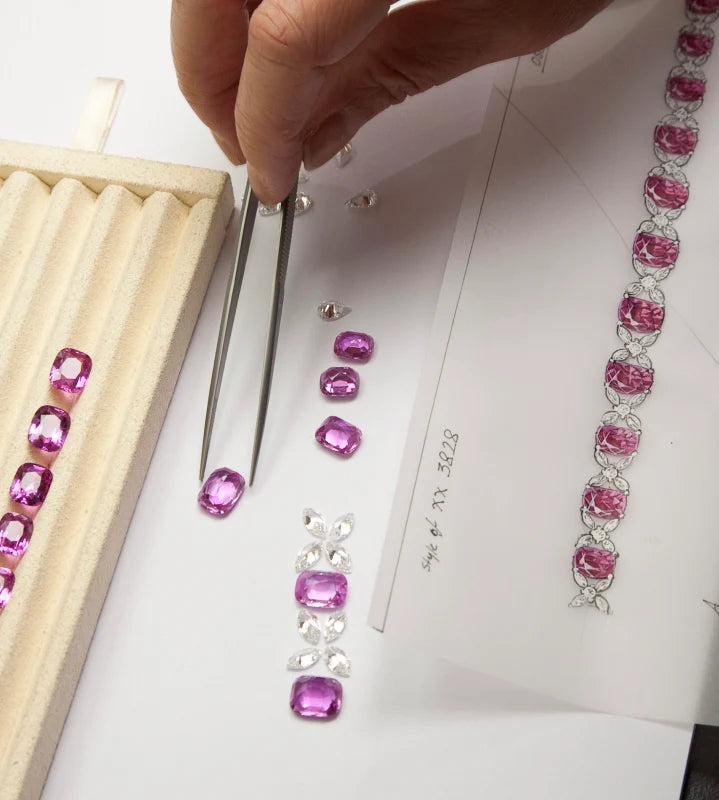
Today, the House maintains meticulous paper archives dating back to 1912. Original job envelopes record the full history of each piece ever created, including gemstone counts and weights, metal specifications, individual artisans involved and their hours, costs, and retailers. Many works are further documented through hand-drawn gouache designs, a practice that remains central to Oscar Heyman’s design process today.
Clients seeking archival research on an estate piece are invited to inquire at concierge@oscarheyman.com.
INFORMED BY THE PAST, DESIGNED FOR THE FUTURE
Learn about the process of transforming gems into jewels at Oscar Heyman’s Madison Avenue workshop.